Not five minutes ago while conducting a Facebook check along with other sites, there was the sudden realization that there was food stuck between my teeth. Actually, it wasn't so sudden since this is a frequent occurrence for me and most likely most of the planet. Look - these are important issues that aren't frequently thought about.
This occurrence wasn't surprising since supper was still being digested accompanied by remnants of the main course, which had lodged themselves between various molars and bicuspids and an occasional incisor. There was no uncertainty of committing a social faux-pas since the meal was 'in house' with only family members around to witness the movement of a finger placed on/between teeth to remove the offensive leftover food particle. Dining out, however, brings up the dilemma of how to disengage an item of food from one's teeth in public.
A common maneuver is a delicate movement around the teeth involved with use of the tongue. A successful outcome is dependent upon the extent and degree of food residue to be removed and whether the operation can be performed without drawing attention to the process. Unsuccessful attempts can result in a release of saliva and/or noise caused by air escaping between the teeth.
"Sorry - it's either this or a finger nail," explanation would not/does not suffice.
Using the contents of a glass of water as a tooth rinse aid is too obvious, especially when or if water is spit back into the glass. Neither is the explanation that one is merely testing the taste of the water. Bringing along an electric toothbrush is crass and too noisy.
Your common toothpick is specifically designed for this purpose but not visually palatable, especially when extricated food remnants are visible at its tip.
Thinking further (obviously too much time on my hands) another subject that has crossed my mind and has social ramifications is the issue of how or whether to blow one's nose amid a table of diners, and/or if it's socially acceptable to use a paper dinner napkin when a tissue isn't available. According to Emily Post of the Emily Post Institute, nose blowing at the table should be limited to small puffs. Big, noisy nose-blowing should be conducted away from the table. This leads one (me) to wonder whether it's advisable to sensitize fellow diners to this faux pas.
"Excuse me," you might say in the way of being helpful, "but you do realize that blowing your nose in public and drawing attention to yourself is boorish and gross."
Some people think deep thoughts about the future of our planet and its inhabitants and then some of us worry about the important issues in life like teeth cleaning and nose- blowing in public. It's just who I am.
Showing posts with label funny. Show all posts
Showing posts with label funny. Show all posts
Thursday, November 24, 2016


Saturday, February 20, 2016
Recognizing special and somewhat unusual holidays
As a writer seeking out potentially interesting subjects to share, there are internet sites that provide background information about diverse holidays, some of which are well known while others are more obscure. It's the lesser-known subject matter that make for interesting reads.
In case you weren't aware and it was definitely news to me, but today being February 20th, is National Love Your Pet Day. This is a great idea especially since pets play an important role as extended members of the family. It's also interesting that the day of pet recognition falls right after Valentine's Day, a day set aside whereby humans demonstrate affection towards a special person in their life. Pets and humans are a natural go-together. Having shared our household with various pets over the years including a dog for fifteen years and various aquatic species many of which didn't last the night and received a two-flush funeral, their contribution to family life should and is noted. Moving along...
Chances are few people are probably aware that February 20 is also National Cherry Pie Day in addition to February being National Cherry Month, a good a reason as any to indulge and cut into a slice or more of juicy scrumptiousness. In searching for background information and according to the American Pie Council, the pie itself came to America with the first English settlers. The early colonists baked their pies in long narrow pans calling them “coffyns”. As in the Roman times, the early American pie crusts often were not eaten, but simply designed to hold the filling during baking. It was during the American Revolution that the term 'crust' was used instead of “coffyn”, which is preferable. I mean, eating cherry pie with a coffyn on top just doesn't do it.
National Hot Tea Month, celebrated for the entire month of January, slipped by without my notice, which is somewhat shameful being a confirmed tea imbiber. The Tea Association of Canada, who know lots about things tea-related, the custom of afternoon tea originated in the 19th century with Anna, 7th Duchess of Bedford, who invited guests to join her for a cup of tea and goodies in the afternoon, to fill the long gap between breakfast and late dinners.
Although purists would probably advocate using loose tea when brewing a pot, tea bags are a personal preference. In spite of using a tea infuser, somehow stray tea leaves seem to work their way through the holes. Spitting the stray tea leaves into a napkin is viewed as a social faux-pas, as is filling up one's mouth with water to cleanse the mouth and returning it into the glass. Somehow, decorum always enters the picture where drinking tea is concerned. Moving right along...
Seems that February 20th has a lot going including - wait for it - National Handcuff Day. Handcuff Day marks the occasion back in 1912, when a patent was granted to George A. Carney for a revolutionary new style of handcuff. The source for this tidbit of information, www.daysoftheyear.com offer some suggestions in the way of celebrating with some trivia questions. I mean, who wouldn't know the answers to:
what kind of handcuff replicas are used in China
which handcuff brand(s) were discontinued and then brought back, and why
who introduced the Gill Flash Action manacle and when that happened
how much standard and other types of handcuffs weigh
which handcuff models are made from stainless steel
what kind of handcuffs people suspected of conspiring against Abraham Lincoln wore
Lesser known and/or more obscure celebrations, which took place earlier in February include Dump Your Significant Jerk Day on February 1. Thinking further regarding this holiday, one doesn't have to wait until February to accomplish this feat, Wave All Your Fingers At Your Neighbors Day on February 7 and National Lash Day on February 19. According to information gleaned from the internet, "This is a day to promote the love and need for true and false eyelashes. It is a day we all can honor our lashes." This leads one - me - to ponder: is it really necessary to honor our eye lashes? What about eye brows? Don't they deserver some recognition, also?
According to Wikipedia, who always seem on top of relating the source of unusual items and articles: "Eyelashes protect the eye from debris and perform some of the same function as whiskers do on a cat or a mouse in the sense that they are sensitive to being touched, thus providing a warning that an object (such as an insect or dust mite) is near the eye (which then closes reflexively)." Nothing unusual about the information however setting aside a day to honor eyelashes is somewhat...unusual, to say or write the least.
All of these diverse celebrations got me thinking that perhaps it's time to add yet another observance, National House Plant Day, to the list in recognition the contribution of houseplants in our lives. I mean, what would our world and lives be without these living organisms, which give us so much pleasure and ask nothing in return except routine doses of fertilizer, an occasional leaf cleaning, re-potting and insect control? Perhaps candidates running for political office should or could offer an adopt-a-plant program, promoting the concept of a house plant in every home to clear the air. Given the extent of promises that are made in an election year, it would be a laudable promise to keep. Right?
In case you weren't aware and it was definitely news to me, but today being February 20th, is National Love Your Pet Day. This is a great idea especially since pets play an important role as extended members of the family. It's also interesting that the day of pet recognition falls right after Valentine's Day, a day set aside whereby humans demonstrate affection towards a special person in their life. Pets and humans are a natural go-together. Having shared our household with various pets over the years including a dog for fifteen years and various aquatic species many of which didn't last the night and received a two-flush funeral, their contribution to family life should and is noted. Moving along...
Chances are few people are probably aware that February 20 is also National Cherry Pie Day in addition to February being National Cherry Month, a good a reason as any to indulge and cut into a slice or more of juicy scrumptiousness. In searching for background information and according to the American Pie Council, the pie itself came to America with the first English settlers. The early colonists baked their pies in long narrow pans calling them “coffyns”. As in the Roman times, the early American pie crusts often were not eaten, but simply designed to hold the filling during baking. It was during the American Revolution that the term 'crust' was used instead of “coffyn”, which is preferable. I mean, eating cherry pie with a coffyn on top just doesn't do it.
National Hot Tea Month, celebrated for the entire month of January, slipped by without my notice, which is somewhat shameful being a confirmed tea imbiber. The Tea Association of Canada, who know lots about things tea-related, the custom of afternoon tea originated in the 19th century with Anna, 7th Duchess of Bedford, who invited guests to join her for a cup of tea and goodies in the afternoon, to fill the long gap between breakfast and late dinners.
Although purists would probably advocate using loose tea when brewing a pot, tea bags are a personal preference. In spite of using a tea infuser, somehow stray tea leaves seem to work their way through the holes. Spitting the stray tea leaves into a napkin is viewed as a social faux-pas, as is filling up one's mouth with water to cleanse the mouth and returning it into the glass. Somehow, decorum always enters the picture where drinking tea is concerned. Moving right along...
Seems that February 20th has a lot going including - wait for it - National Handcuff Day. Handcuff Day marks the occasion back in 1912, when a patent was granted to George A. Carney for a revolutionary new style of handcuff. The source for this tidbit of information, www.daysoftheyear.com offer some suggestions in the way of celebrating with some trivia questions. I mean, who wouldn't know the answers to:
Lesser known and/or more obscure celebrations, which took place earlier in February include Dump Your Significant Jerk Day on February 1. Thinking further regarding this holiday, one doesn't have to wait until February to accomplish this feat, Wave All Your Fingers At Your Neighbors Day on February 7 and National Lash Day on February 19. According to information gleaned from the internet, "This is a day to promote the love and need for true and false eyelashes. It is a day we all can honor our lashes." This leads one - me - to ponder: is it really necessary to honor our eye lashes? What about eye brows? Don't they deserver some recognition, also?
According to Wikipedia, who always seem on top of relating the source of unusual items and articles: "Eyelashes protect the eye from debris and perform some of the same function as whiskers do on a cat or a mouse in the sense that they are sensitive to being touched, thus providing a warning that an object (such as an insect or dust mite) is near the eye (which then closes reflexively)." Nothing unusual about the information however setting aside a day to honor eyelashes is somewhat...unusual, to say or write the least.
All of these diverse celebrations got me thinking that perhaps it's time to add yet another observance, National House Plant Day, to the list in recognition the contribution of houseplants in our lives. I mean, what would our world and lives be without these living organisms, which give us so much pleasure and ask nothing in return except routine doses of fertilizer, an occasional leaf cleaning, re-potting and insect control? Perhaps candidates running for political office should or could offer an adopt-a-plant program, promoting the concept of a house plant in every home to clear the air. Given the extent of promises that are made in an election year, it would be a laudable promise to keep. Right?
Wednesday, December 23, 2015
Hey! It's Festivus for the rest of us
This year, wanted to make sure that the holiday of Festivus is marked on the day the holiday occurs. In previous years, somehow it slipped by without recognition until the day after. Not that it really makes a difference in the scheme of things but holidays should be celebrated on the day they take place.
For the uninformed, this holiday got its start as a segment on the still-lamented TV comedy series, "Seinfeld" with Frank Constanza, George's father, who explains the holiday this way.
"Many Christmases ago, I went to buy a doll for my son. I reached for the last one they had, but so did another man. As I rained blows upon him, I realized there had to be another way." The doll was destroyed but as George elaborated, "out of that a new holiday was born: a Festivus for the rest of us!"
The holiday is unique in that it includes the Airing of Grievances and Feats of Strength. Who among us hasn't or doesn't air our grievances at some point? Speaking for myself because nobody else will, I recently aired a grievance at the supermarket, when returning rotten cheese.
"I'm now Airing my Grievances," I told the cashier emphatically, hands on hips for emphasis. "This cheese has a good-until date for three months from now and yet here we are, not two weeks later with mold."
Doubtful that the cashier was aware of the Airing of Grievances occasion in spite of numerous attempts to explain and offers to listen to her grievances, but she still gave me my money back, anyway. Not everyone wants to share.
In as far as Feats of Strength are concerned, just this morning I brought a trash bag filled to capacity to the disposal shoot and tossed it in holding it in one hand. Two days ago I walked along a slush-filled sidewalk, ignoring the option to walk on the dry road. These are praise-worthy feats, friends!
Last but certainly not least, there's the Festivus Pole, in which an un-decorated aluminum pole is displayed in place of a Christmas tree. One could, if one felt moved, dance around the pole or perhaps - just a thought - string up some cord and hang laundry. A pole is a pole is...
So once the binge-watching of TV series has lost its charm and all the gifts are wrapped, and the cat has re-decorated the tree as only cats can do, get the gang together and hold hands singing around the Festivus pole. Why? Why not?
Grievances aired, are you listening,
At the dinner, meatloaf is glistening.
A beautiful sight, we're happy tonight.
It's Festivus all across the land.
Standing there, is an old pole,
Unadorned, it is a strong pole.
It stands straight and tall,
As we go along,
It's Festivus all across the land.
In the Living Room we can wrestle,
And try to pin the head of the house.
He'll say: Are you ready?
We'll say: No, man.
But we will do our best
To pin him down.
Later on, we'll conspire,
As we air grievances by the fire.
To face unafraid,
The gripes we have made,
It's Festivus all across the land.
For the uninformed, this holiday got its start as a segment on the still-lamented TV comedy series, "Seinfeld" with Frank Constanza, George's father, who explains the holiday this way.
"Many Christmases ago, I went to buy a doll for my son. I reached for the last one they had, but so did another man. As I rained blows upon him, I realized there had to be another way." The doll was destroyed but as George elaborated, "out of that a new holiday was born: a Festivus for the rest of us!"
The holiday is unique in that it includes the Airing of Grievances and Feats of Strength. Who among us hasn't or doesn't air our grievances at some point? Speaking for myself because nobody else will, I recently aired a grievance at the supermarket, when returning rotten cheese.
"I'm now Airing my Grievances," I told the cashier emphatically, hands on hips for emphasis. "This cheese has a good-until date for three months from now and yet here we are, not two weeks later with mold."
Doubtful that the cashier was aware of the Airing of Grievances occasion in spite of numerous attempts to explain and offers to listen to her grievances, but she still gave me my money back, anyway. Not everyone wants to share.
In as far as Feats of Strength are concerned, just this morning I brought a trash bag filled to capacity to the disposal shoot and tossed it in holding it in one hand. Two days ago I walked along a slush-filled sidewalk, ignoring the option to walk on the dry road. These are praise-worthy feats, friends!
Last but certainly not least, there's the Festivus Pole, in which an un-decorated aluminum pole is displayed in place of a Christmas tree. One could, if one felt moved, dance around the pole or perhaps - just a thought - string up some cord and hang laundry. A pole is a pole is...
So once the binge-watching of TV series has lost its charm and all the gifts are wrapped, and the cat has re-decorated the tree as only cats can do, get the gang together and hold hands singing around the Festivus pole. Why? Why not?
It's Festivus all Across the Land
(Sung to the tune of "Winter Wonderland")Grievances aired, are you listening,
At the dinner, meatloaf is glistening.
A beautiful sight, we're happy tonight.
It's Festivus all across the land.
Standing there, is an old pole,
Unadorned, it is a strong pole.
It stands straight and tall,
As we go along,
It's Festivus all across the land.
In the Living Room we can wrestle,
And try to pin the head of the house.
He'll say: Are you ready?
We'll say: No, man.
But we will do our best
To pin him down.
Later on, we'll conspire,
As we air grievances by the fire.
To face unafraid,
The gripes we have made,
It's Festivus all across the land.
Thursday, October 08, 2015
The Ig Nobels - recognizing achievement for...stuff
There are well-known prestigious awards distributed to those who gain international recognition in various fields of achievement in the sciences, literature and/or are successful in various scopes of performance and related areas. Then there are lesser known distinctions bestowed to people whose contribution to society could be, but not necessarily, considered somewhat questionable or at the very least, head-scratching-inducing.
Somehow, the 2015 Ig Nobel Prizes almost slipped by on my part, without any of the usual acknowledgement and commendation to the winners. These are achievements that elicit laughs but are also thought-provoking. This year's winners gathered together on September 17 at a ceremony at Harvard University's Saunders Theatre, followed by a lecture at MIT. These people went home with an Ig Prize:
The prize for Chemistry went to Calum Ormonde and Colin Raston (Australia), Tom Yuan, Stephan Kudlacek, Sameeran Kunche, Joshua N. Smith, William A. Brown, Kaitlin Pugliese, Tivoli Olsen, Mariam Iftikhar, Gregory Weiss (USA), for their invention of a chemical recipe to partially un-boil an egg. This is no yolk...eggs-actly.
The rationale behind the desire to un-boil an egg is curious but then again, one could ask oneself whether an egg is half-boiled or not, would it make a difference to a hen? Just thinking...
In the science of Physics, Patricia Yang (USA and Taiwan), David Hu (USA and Taiwan), Jonathan Pharm and Jerome Choo (USA), who tested the biological principale that nearly all mammals empty their bladders in approximately 21 seconds (plus or minus 13 seconds).
Contemplating further, one (me) wonders whether this would vary following a night of alcoholic indulgence. Just thinking...
So Mark Dingemanse (The Netherlands), USA), Francisco Torreira (The Netherlands, Belgium, USA) AND Nick J. Enfield (Australia, The Netherlands), who took home the Literature Prize, for their earth-shattering discovery - wait for it - that the word, "huh" (or its equivalent) seemed to exist in every human language - and for not being quite sure why.
Would depend, IMHO, if one considers "huh" a word uttered on purpose or merely an exhalation of breath on a windy day. What about the Canadian equivalent of "eh:? Where does that fall in the scheme of things? Just wondering...
In the area of Management, Gennaro Bernile (Italy, Singapore, USA), Vineet Bhagwat (USA, India) and P. Raghavendra Rau (UK, India, France, Luxembourg) in their discovery that many business leaders developed a fondness for risk-taking in childhood when they experienced natural disasters i.e. earthquakes et al that - for them - had no dire personal consequences.
Now here is something worthy of recognition. The Bangkok Metropolitan Police were recognized in the Economics area (Thailand), for offering to pay policemen extra cash if the policemen refused to take bribes.
For the Medicine prize, two groups received the honors jointly - perhaps they were testing their experiments: Hajime Kimata (Japan, China), Jaroslava Durdiakova (Slovakia, US, UK), Peter Celec (Slovakia, Germany) Natalia Kamodyova, Tatiana Sedlackova, Gabriela Repiska, Barbara Sviezena and Gabriel Minarik (Slovakia), for their study examining the biomedical benefits or biomedical consequences of intense kissing (and other intimate, inter-personal activities).
So how this falls into the medical sphere is interesting but even more interesting would be what type of activities did they conduct to arrive at their conclusions. Right?
The prize in Mathematics was awarded to Elisabeth Oberzaucher (Austria, Germany, UK) and Karl Grammer (Austria, Germany), for trying to use mathematical techniques to determine whether and how Moulay Ismael the Bloodthirsty, the Sharifian Emperor of Morocco, managed during the years from 1697 through 1727, to father 888 children.
Yet another chicken aspersion in the Biology prize category. Bruno Grossi, Omar Larach, Mauricio Canals, Rodrigo A. Vaszuez (Chile), Jose Iriarte-Diaz (Chile, USA), for observing that when one attaches a weighted stick to the rear end of a chicken, the chicken then walks in a manner similar to that in which dinosaurs are thought to have walked.
Why do chickens have to suffer indignities like having a weighted stick attached to their rear end? I mean, is there a reason? It's bad enough having to speculate about their motivation for crossing the road/highway/street etc. and now being categorized as walking like a dinosaur? Really and when you think about it (too much time on my hands, obviously), who was around to witness the manner in which dinosaurs walked, anyway? Am I wrong, readers?
I dunno. Some people really seem to enjoy pain, Two individuals, one Justin Schmidt (USA, Canada) for painstakingly (in the true sense of the word) creating the Schmidt Sting Pain Index that rates the relative pain people feel when stung by various insects.
Really.
Also, Michael L. Smith (USA, UK, The Netherlands) in the area of Physiology and Entomology, for carefully arranging for honey bees to sting him repeatedly on 25 different locations on his body, to learn, which locations are the least painful (the skull middle, toe tip and upper arm) and which are the most painful (the nostril, upper lip and - can't believe I'm writing this - penis shaft).
It's really difficult to believe that someone, even in the name of science, would allow a/some bees to sting him on the penis shaft. Bee+stinger+penis=extreme pain.
And so yet another year of dubious distinctions has come and gone but definitely not without notice or accolades. Next year - who knows. The mind boggles.
Tuesday, July 14, 2015
This'n'that: observations du jour : #2
It's all a numbers game in the end
Like many people in the cyber space community, I'm a Twitter user, some may call us twits but that's a whole other subject. According to Twitter stats, which keep track of these things, I've been a twitter-er since 2009. Way back then, everyone was joining the group and as a writer it seemed like a good medium in which to let people know about my creative output. The idea is to communicate one's present status in 140 characters and keep people coming back for more entertaining personal revelations that fall into "what's happening" category. My philosophy in as far as sharing Twitter updates is share if it's an interesting and/or entertaining subject that will elicit a response. Therein lays the challenge: getting people to respond. What may strike my fancy doesn't necessarily interest others.
As a playwright or at least a person who writes plays, it's an ideal tool in which to give Twitter followers a taste of my plays. This seems to attract attention and accordingly the stats go up. Lately, though, it appears my numbers have dropped, which leads me to the point of this piece. The other day, there was an e-mail announcement notifying me to avail myself of the "Twitter Analytics" service and according to their blurb, "you're putting out there, so it's time you were able to see what's getting the most love." Usually, I'm an adherent of ignorance is bliss but decided to get an appraisal of my virtual worth. According to their statistics and within a 28 day period, I had 22 profile visits, a drop of 15.4%, 3 mentions indicating a 50% hike in numbers, my top tweet earned 26 impressions (whatever that is) with the subject focusing on a robot marriage. In my defence, there have been numerous requests (okay...a lot of requests) by people to be followed that have been refused for one reason or another, so that in itself decreases the number of people who might have been slighted at my refusal, which in turn is reflected in the statistics. In the end, there is the consolation that at least my 643 Twitter followers - an increase of 9 by the way - are tweet on each other.
Note: discovered what "Impressions" are and according to Twitter: "When we say "impression", we mean that a tweet has been delivered to the Twitter stream of a particular account. Not everyone who receives a tweet will read it , so you should consider this a measure of potential impressions. Both reach and impressions should be treated as directional metrics to give you an idea of the overall exposure the tracked term received. Use these metrics to get a sense of the size of your potential audience, and use engagement metrics like retweets, clicks and replies to gain a more complete understanding of your impact."
So...like...maybe it's just me but my impression is that I still don't understand what impressions are. You?
The bike-cycle
As a person who enjoyed cycling through suburban streets as a means of exercise and getting around, I'm aware of the appeal in participating in this great cardio sport, however... Why do many cyclists feel that red lights don't apply to them? They fly through intersections without even bothering to slow down, daring motorists to impede their pace. Given their means of transportation versus a car, their lack of concern for stop signs and/or traffic lights is intimidating, not to mention anxiety inducing. On occasion and being who I am, I'll point out the red light/stop sign. Most ignore me but I've received the middle finger on occasion for my effort. Wonder how many tickets have actually been given out to cyclists by police. Traffic rules are for everyone, including cyclists.
Making a splash
To the best of my knowledge, a swimming pool being filled with water, is designed for people to swim and/or enjoy water-related activities. Sometimes...many times people will splash water on each other by accident causing them to get wet. For whatever reason, some people - females for the most part - make it verbally known that they are against splashing of any type. The most frequent complaint heard (at least in our condo pool) is "don't splash my hair!" Well ladies who fall into this category, a reminder that perhaps the best action to take is to stay out of the pool and thereby avoiding the possibility of being splashed, period. Water is wet! At least that's my solution but if anybody else has a better suggestion...
Question du jour
Can't help but notice there's an inequality when it comes to serving tea and coffee ("there she goes again - ranting on about tea bags..."). In cafes which serve coffee and tea, where do tea drinkers put their tea bags once the correct strength is achieved and they're no longer needed? Somehow, placing it on a bare table or napkin just seems so...un-couth. Perhaps a small disposable receptacle should be supplied when served tea, in which to place the tea bag. Something like this:
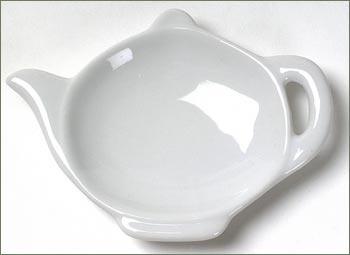
Just saying...
Like many people in the cyber space community, I'm a Twitter user, some may call us twits but that's a whole other subject. According to Twitter stats, which keep track of these things, I've been a twitter-er since 2009. Way back then, everyone was joining the group and as a writer it seemed like a good medium in which to let people know about my creative output. The idea is to communicate one's present status in 140 characters and keep people coming back for more entertaining personal revelations that fall into "what's happening" category. My philosophy in as far as sharing Twitter updates is share if it's an interesting and/or entertaining subject that will elicit a response. Therein lays the challenge: getting people to respond. What may strike my fancy doesn't necessarily interest others.
As a playwright or at least a person who writes plays, it's an ideal tool in which to give Twitter followers a taste of my plays. This seems to attract attention and accordingly the stats go up. Lately, though, it appears my numbers have dropped, which leads me to the point of this piece. The other day, there was an e-mail announcement notifying me to avail myself of the "Twitter Analytics" service and according to their blurb, "you're putting out there, so it's time you were able to see what's getting the most love." Usually, I'm an adherent of ignorance is bliss but decided to get an appraisal of my virtual worth. According to their statistics and within a 28 day period, I had 22 profile visits, a drop of 15.4%, 3 mentions indicating a 50% hike in numbers, my top tweet earned 26 impressions (whatever that is) with the subject focusing on a robot marriage. In my defence, there have been numerous requests (okay...a lot of requests) by people to be followed that have been refused for one reason or another, so that in itself decreases the number of people who might have been slighted at my refusal, which in turn is reflected in the statistics. In the end, there is the consolation that at least my 643 Twitter followers - an increase of 9 by the way - are tweet on each other.
Note: discovered what "Impressions" are and according to Twitter: "When we say "impression", we mean that a tweet has been delivered to the Twitter stream of a particular account. Not everyone who receives a tweet will read it , so you should consider this a measure of potential impressions. Both reach and impressions should be treated as directional metrics to give you an idea of the overall exposure the tracked term received. Use these metrics to get a sense of the size of your potential audience, and use engagement metrics like retweets, clicks and replies to gain a more complete understanding of your impact."
So...like...maybe it's just me but my impression is that I still don't understand what impressions are. You?
The bike-cycle
As a person who enjoyed cycling through suburban streets as a means of exercise and getting around, I'm aware of the appeal in participating in this great cardio sport, however... Why do many cyclists feel that red lights don't apply to them? They fly through intersections without even bothering to slow down, daring motorists to impede their pace. Given their means of transportation versus a car, their lack of concern for stop signs and/or traffic lights is intimidating, not to mention anxiety inducing. On occasion and being who I am, I'll point out the red light/stop sign. Most ignore me but I've received the middle finger on occasion for my effort. Wonder how many tickets have actually been given out to cyclists by police. Traffic rules are for everyone, including cyclists.
Making a splash
To the best of my knowledge, a swimming pool being filled with water, is designed for people to swim and/or enjoy water-related activities. Sometimes...many times people will splash water on each other by accident causing them to get wet. For whatever reason, some people - females for the most part - make it verbally known that they are against splashing of any type. The most frequent complaint heard (at least in our condo pool) is "don't splash my hair!" Well ladies who fall into this category, a reminder that perhaps the best action to take is to stay out of the pool and thereby avoiding the possibility of being splashed, period. Water is wet! At least that's my solution but if anybody else has a better suggestion...
Question du jour
Can't help but notice there's an inequality when it comes to serving tea and coffee ("there she goes again - ranting on about tea bags..."). In cafes which serve coffee and tea, where do tea drinkers put their tea bags once the correct strength is achieved and they're no longer needed? Somehow, placing it on a bare table or napkin just seems so...un-couth. Perhaps a small disposable receptacle should be supplied when served tea, in which to place the tea bag. Something like this:
Just saying...
Monday, April 27, 2015
Laugh it up! April is National Humor Month
"Humour or humor (see spelling differences) is the tendency of particular cognitive experiences to provoke laughter and provide amusement. The term derives from the humoral medicine of the ancient Greeks, which taught that the balance of fluids in the human body, known as humours (Latin: húmor, "body fluid"), control human health and emotion". ~Wikipedia
Once again as it occurs every year since 1976, National Humor Month is celebrated around the world by people who have a sense of humor. Perhaps even people who don't have a sense of humor but enjoy the mere act of laughing out loud, or in private, but I digress.
It's interesting to note that a month devoted to humor starts on April 1st being April Fools Day. For the record, Larry Wilde is responsible for the creation of National Humor Month, which devotes the entire month to laughter. His aim was and presumably still is, to heighten public awareness of how the joy and therapeutic value of laughter can improve health, boost morale, increase communication skills and enrich the quality of one's life.
Researcher, Robert R. Provine, a neuro-scientist engaged in studies of the development, evolution and neural mechanisms of behavior, has focused on studying laughter and observed thousands of incidents of laughter spontaneously occurring in everyday life. He shared his findings in Laughter: A Scientific Investigation (Penguin Books, 2001).
"Laughter is not primarily about humor," wrote Dr. Provine, "but about social relationships."
Among some of his surprising (at least to me) findings:
- Health benefits of laughter are probably coincidental, a consequence of a much more important primary goal, which is bringing people together. Not too sure if he's entire right, at least IMHO. Given the choice, people would prefer to laugh than cry. Right?
- Laughter plays a big role in mating. Men like women who laugh heartily in their presence. Won't touch that one with a ten-foot pole.
- Both sexes laugh a lot but females laugh more - 126% more than their male counterparts. Men are more laugh-getters
- The laughter of the female is the critical index of a healthy relationship. Again, this is a questionable statement. I mean, it would depend on the reason for the female's laughter. Is it at or with the person?
- Laughter in relationships declines dramatically as people age
Interesting statistic that females laugh 126% more than males. Perhaps - pure speculation and some observation - females have a better sense of humor. By laugh-getters I'm assuming that they prefer to get/acquire the laughs, which in turn the females will respond by laughing or in some cases, rolling their eyes.
Another theory of why people laugh professes that people laugh to assert that they are on a level equal to or higher than those around them. Research has shown that bosses tend to crack more jokes than do their employees. I would also imagine that employees laugh at their bosses jokes for obvious reasons, especially if a raise in salary is imminent.
Women laugh much more in the presence of men and men generally tell more jokes in the presence of women. Men have even been shown to laugh much more quietly around women, while laughing louder when in a group of men. Males could consider laughing quietly while in the presence of females to be polite. I mean, a loud, coughing and snorting laugh could be considered brash or socially unacceptable. JMHO of course...
Over the years researchers have explored laughter's effects on the body and produced some interesting information on how it affects us. For example, a study conducted by researchers of the University of Maryland studied the effects on blood vessels when people were shown either comedies or dramas and concluded that blood vessels of the group watching comedies expanded and contracted easily, while the blood vesssels of the people watching dramas tended to tense up restricting blood flow. More proof?
There's scientific evidence that it may offer protection against a heart attack. A study with results presented at the American Heart Association's 73rd Scientific Session showed that people with heart disease were 40% less likely to laugh in a variety of situations compared to people of the same age without heart disease. This all means that it's good for your health to laugh.
In honor of this month of merriment, here are some jokes. Warning: some are groaners.
- Two cannibals were eating a clown. One said to the other: "Does this taste funny to you?"
- Did you hear about the man who spent too much money on Viagra: Now, he's hard up
- Did you hear about the guy that lost his left arm and leg in a car crash?
He's all right now.
- What do you call four bull fighters in quicksand?
Quatro sinko.
Some questions worth thinking about:
- Why are there interstate highways in Hawaii?"~ Steve Wright
- Why is abbreviation such a long word?~ Steve Wright
- Dogs are the leaders of the planet. If you see two life forms, one of them's making a poop, the other one's carrying it for him, who would you assume is in charge.
~ Jerry Seinfeld
Don't know who wrote this but it best sums up being happy: "Laughter is the shock absorber that eases the blows of life."
Meanwhile - laugh it up!
Tuesday, April 07, 2015
It takes all kinds - this...that...and all the others
Life with all its complexities and challenges, is full of interesting stories focusing on people living out their lives doing interesting if somewhat perplexing things at times. No need to travel far to come across these real-life stories that can be found with a quick click of the mouse, the electronic kind.
Getting to the source of dog poop
As a former dog owner for fifteen years, one of the more distasteful tasks connected with pet care is having to pick up dog excrement, especially in Spring. Legally and morally, dog owners are responsible for cleaning after their pooch has finished by bringing along disposal bags, but many people adopt the 'hit-and-run' method - fleeing the scene once the job (in the true sense of the word) is over.
Seems that people living in apartment complexes in the Seattle area that have had their fill of dog poop are seeking the identity of canine culprits using - wait for it - DNA testing. To this end (again in the true sense of the word), owners are being provided with a test kit called PooPrints provided by one BioPet Vet Lab from Knoxville, TENN. that will help seek out guilty poop-ers. Some apartment and condo tenants are even being charged a one-time fee of $29.95 for this testing service most likely if they own dogs.
So I'm thinking here...
What if a dog owner refuses to allow her/his pooch to participate? I mean, dogs do have some rights, right? After all, it is their feces, right?
According to the Poo-Prints site, dogs are registered on line (presumably) after which a poop sample is collected to be registered with the patented DNA World Pet Registry for managing community dogs. Matching the poop samples with the dog(s) in question is a means used ascertain who did what where. Very high tech in as far as dog poop is concerned. However, one wonders what would happen in the case of poop mis-identification.
"Did you receive the DNA I sent you last night?" an apartment manager might call in the way of a follow-up.
"We did but somehow it doesn't seem to match any DNA records of local neighborhood dogs," the DNA collector could/might/possibly answer.
"Whad'ya mean?" the apartment manager most likely would respond, irately. "I supplied you with all the DNA of all the dogs in this complex and now you're telling me you can't find the pooper?"
"Could be an out-of-town visitor or maybe a dog from another 'burb. You know, a dog out with its owner taking an evening stroll," the DNA collector would attempt to explain.
"What am I supposed to do now?" the apartment manager would ask.
"In cases like that, we advise the person in charge to take things into their own hands, if you get my drift."
In the end, a dog's gotta do what a dog's gotta do in spite of high tech poop testing.
A wedding of a different breed
People on occasion, may question the choice of mate when it comes to the band of matrimony but this is a bit much. An obviously love-stricken man for whatever reason (to each their own) decided to marry a specie of a different sort after being convinced that he was fated to share his life with a cobra. A cobra as in dangerous snake that has other things on its mind than marriage.
The groom was positive that the bride-to-be/cobra was once a beautiful female in a previous life who was now in love with him. Furthermore and to complete the mating, he claimed that he could turn into a snake at night by entering a deep trance. Seems that the bride/cobra had promised to marry him on Easter Sunday.
Obviously, many people believed him since between 12,000 and 15,000 turned up to watch the ceremony. Thinking further, wonder if the bride wore white. But I digress
According to the priest that was to do the nuptials, the groom had exhibited traits of a snake since childhood. I'm sure many people can say that about human they've encountered in their lifetime but I digress. Again.
However, the marriage was not to be when the police put in an appearance after being tipped off about the nuptials. So I'm thinking here, wonder what their wedding night would have been like had the marriage gone ahead. In the end, can you really trust a snake given their reputation for lying?
Speaking of snakes...
What is it with all this snake abuse? Arrest warrents were issued for two males accused of throwing a snake behind the counter of donut chain, Tim Hortons in Saskatoon, Saskatchewan, as a result of a sandwich dispute. Some people obviously take their sandwiches very seriously. Anywaaay...
The pair are charged with mischief and causing a disturbance. Most likely throwing a snake behind a counter would definitely cause a disturbance. The cause of the disturbance was that they wanted the onions on their sandwiches, diced. Really, the snake should not have to suffer the consequences of an onion dispute. No word on the snake's condition but a temporary home was found for the serpent.
Last but not least - looking for a job with a difference?
The Isles of Scilly, a group of rocky islands off the southwestern tip of Britain, is currently seeking a new constable that can handle a lot of jobs. For example, dealing with wandering seal pups, stopping speeding golf carts and saving abandoned goldfish (some people would say that the sewer pipes are home to many of their kind).
The island is home to approximately 2,200 people. For information, check the Scilly page on Facebook https://www.facebook.com/IslesofScillyPolice
And how was your week?
Thursday, February 19, 2015
Getting to the heart of the sucker and other obscure but somewhat interesting stuff
Over the years but particularly as a youngster, lollipops were a licking good treat offering long term flavor at a reasonable cost. For the record, lemon was a personal favorite with grape coming in a close second. It was also a versatile offering in that it could be picked up and put down numerous times until it slowly disappeared altogether.
Haven't actually given it deep thought or even superficial reflection but obviously a branch of science has pondered the dilemma of the amount of licks it takes to get to the center of a lollipop. This begs (at least in my mind ) the question as to why bother. When a lollipop is gone - it's gone. Right? What's important is the enjoyment is gave the lick-er and the taste thereof. People in the scientific community, however, who enjoy delving into numbers, have studied this mind-boggling enigma.
Researchers at New York University conducted experiments to analyze and test how lollipop solid dissolves. The conclusion reached based on mathematical principals was that it takes approximately 1000 licks to get to the center of a Tootsie Roll Pop. Why Tootsie Roll Pop? Who knows. The real question is do sucker-lovers care?
But I digress.
The scientific study involved the creation of custom-making candy spheres and cylinders to test how materials dissolve in a flow. I'm no scientist but let me state for the record that lollipop+tongue+saliva and a warm mouth causes the solid lollipop to slowly dissolve into nothingness. Anyway... Study leader and physicist, Leif Ristroph, found that the presence of the solid interrupts the flow, forces it to bend and change directions. Wow! Never would have thought it..in the true sense of the word.
Furthermore (how much more excitement can we take, one wonders), tests of both spherical lollipop-candies and Jolly Rancher style cylinders resulted in the same half-sphere shape after a little time in the fluid flow. I mean, go figure and be still my beating heart! But wait - there's more! The researchers deduced from the experiments that a lollipop with a radius of 0.4 inches (1 cm) licked at the equivalent to a flow rate of 1 cm per second would reveal its center in about 1,000 licks. So this makes one wonder what would be the end result of say...a person licked faster or slower? Does speed enter into this mind boggler?
When it all said and done or written, still have to wonder the rationale behind conducting this type of research. All good things come to an end, even lollipops and I'm no sucker.
Crawling on...
Cockroaches Have Personality but do we care?
A small but generally unknown fact that people reading this might not have been aware of or even made a point of investigating, but it appears - wait for it - researchers have made the amazing (at least in my eyes) finding that your ordinary cockroaches have personality! I mean, who would'a thought it!
Once again, one ponders and/or wonders the motivation behind taking time to study the social aspects of cockroach life. For most people.. Okay. For many people, the mere sight of a cockroach is enough to elicit a high pitch noise from the throat followed by the appearance of a means in which to eradicate the source. But I digress.
The findings were part of a study published in the Proceedings of the Royal Society B, who ascertained that when cockroaches spend enough time with each other, they tend to flock together. Thinking further (too much time on my hands), one ponders if it's for social reasons or perhaps and more likely, the sharing of information as to the best food offerings. Whatever... it was all part of an experiment in which cockroaches were placed together in an illuminated arena along with a couple of dark shelters constructed from plastic discs. Researchers studied how the various roaches responded to the sudden glare of light, given that they are night freeloaders. Some sought shelter quickly while others stayed out longer. However - now this is telling - when 16 roaches were thrown in the arena together, they came to a consensus as to when and where to seek shelter. Group bug telepathy, perhaps? But I digress...again.
What does this all mean in the big picture? One could deduce that some cockroaches are night crawlers preferring to seek food and goodies in the cover of darkness, while others aren't so fussy and will tolerate light depending on what's accessible. On a personal note, surely there are scientific studies that could help man/.woman-kind than studying cockroaches. Next thing we'll hear about is the creation of sunglasses for cockroaches and other night foragers. For most of us, the only good cockroach are those that can no longer see the light of day if you get my drift.
Sometimes you can't win for losing
The arrival of Groundhog Day in February, is an opportunity for a few lucky and pampered rodents, the most well-known among them being Punxsutawney Phil, to leave their den in the name of science and predict the early or late arrival of Spring. However, given the various geographical locations and weather variations, regional groundhogs located across the country are consulted as local harbingers of Spring.
For whatever reason, some groundhogs don't enjoy the limelight and one Jimmy the Groundhog who has a burrow in Sun Prairie, Wisconsin, showed his displeasure by taking a nip out of the ear of then Mayor Jon Freund. Nip or not, Freund proclaimed that an early Spring was on its way. Too bad that Jimmy wasn't politically inclined or he could also have predicted that Freund, who was appointed mayor of Sun Prairie in 2014, would place third in the primary election knocking him out of Sun Prairie's Mayor's race. Seems that sympathy goes only so far among voters.
How was your week?
Wednesday, October 15, 2014
A-choo! Counting the sneezes in life
"If you want to make a person feel better after they sneeze, you shouldn't say 'God bless you.' You should say 'You're so good looking!'"
- Jerry Seinfeld, in "The Good Samaritan"
A flurry of successive sneezes for a day or more can be a sign that a cold is imminent. However, sneezing has taken on a whole new meaning for one person.For whatever reason - maybe boredom or just something that struck his fancy - go know - David Fletcher who calls Birmingham, UK home, has been counting wait for it - his sneezes since 2007. That's nothing to sneeze at. Couldn't resist writing that but I digress. Anyway...
There was no real reason or motivation that compelled him to start counting sneezes.
"What started out as a little conceptual art joke, a playful satire of the “blogosphere”, and a mock scream against the futility and emptiness of modern life, turned into something more intriguing", Fletcher explained in his blog, Sneezecount, http://sneezecount.joyfeed.com/about/
In his blog, Fletcher keeps a daily count of the number of times he sneezes in one day including the time, date, his location at the time and a brief description of his activity at that time. He also offers a description and guide of the strength of the sneeze i.e. mild, moderate to very strong, which he records in a notebook and transfers to his blog.
In his "Reflections on the Counting of Sneezes", the sneezer shares some of his findings since beginning his undertaking. In addition to noting the number of times he sneezes, he also documents his activity at the time. For example:
July 2007 - accumulation of 36 sneezes
Place: Bedroom
Strength of sneeze: Mild
Activity: Just finished cup of tea
He is still counting and is now up to 4,059 accumulative sneezes since he started.
This got me thinking. We could, if we really had a lot of time on our hands and wanted something to do, keep a blog of similar activities, like coughing for example.
Thursday, October 16 - 3 coughs
Place: kitchen, den, bathroom
Strength of cough: 2 regular, 1 choking on water that went down the wrong way
Activity: washing dishes, watching TV, drinking liquid with supper
Friday, October 17 - 12 burps
Place: kitchen, den
Strength of burps: 2 mild, 3 medium, 2 medium-strong, 5 strong
Activity: eating chili, watching football on TV (beer involved)
The possibilities are endless like keeping track of the number of times one blinks, uses a tissue to wipe the nose, yawning, scratching one's nose... Meanwhile, my philosophy in as far as sneezing is concerned is a sneeze is a nose tickle looking for a way to get out. Or something.
Wednesday, September 24, 2014
Celebrating the quirkiness in all of us - 2014 Ig Nobel Prize winners announced
Some people are recognized for achievements in academics, or in the sports arena or in the entertainment business... your "normal" type of accomplishments. Then there are others who strive to be remembered for their unconventional undertakings and leave their mark on the world, be it a quirky train of thought.
Once again as in past years, the Ig Nobel Prizes were handed out with the 2014 ceremony held on September 18. For the uninitiated and those wondering if there's any relationship to the famous Nobel Prizes, these awards, according to the Annals of Improbable Research magazine with the ceremony co-sponsored by the Harvard-Radcliffe Society of Physics Students and the Harvard-Radcliffe Science Fiction Association, are to "celebrate the unusual, honor the imaginative — and spur people's interest in science, medicine, and technology." Judge for yourselves.
Physics Prize (Japan), specifically Kiyoshi Mabuchi, Kensei Tanaka, Daichi Uchijima and Rina Sakai, for measuring the amount of friction between a shoe and a banana skin, and between a banana skin and the floor, when a person steps on a banana skin that's on the floor.
I mean, do we really need to know the amount of friction when one steps on a banana skin when and/or if one's rear end meets the ground? Perhaps the speed of falling...
Neuroscience Prize (China/Canada), specifically Jiangang Liu, Jun Li, Lu Feng, Ling Li, Jie Tian, and Kang Lee, for trying to understand what happens in the brains of people who see the face of Jesus in a piece of toast.
Most of us see your usual, mundane jam, peanut butter and the like, while others see unusual images...
Psychology Prize (Australia, U.S.A. UK) specifically Peter K. Jonason, Amy Jones, and Minna Lyons, for amassing evidence that people who habitually stay up late are, on average, more self-admiring, more manipulative, and more psychopathic than people who habitually arise early in the morning.
Public Health Prize (Czech Republic, Japan, USA, India), specifically Jaroslav Flegr, Jan Havlíček Jitka Hanušova-Lindova, David Hanauer, Naren Ramakrishnan, Lisa Seyfried, for investigating whether it is mentally hazardous for a human being to own a cat.
Perhaps somewhat alienating given the affectionate nature of cats but nothing compared to owning fish and the affection they offer to their care givers, which is relegated to rising to the top of the tank for food but otherwise zilch, nada... But I digress.
Biology Prize (Czech Republic, Germany, Zambia) specifically Vlastimil Hart, Petra Nováková, Erich Pascal Malkemper, Sabine Begall, Vladimír Hanzal, Miloš Ježek, Tomáš Kušta, Veronika Němcová, Jana Adámková, Kateřina Benediktová, Jaroslav Červený and Hynek Burda, for carefully documenting that when dogs defecate and urinate, they prefer to align their body axis with Earth's north-south geomagnetic field lines.
Most likely few and far between dog owners note or even want to or have thought about which direction their dogs defecate and urinate, being concerned with having to pick up the end result. Right dog owners?
Art Prize (Italy), specifically Marina de Tommaso, Michele Sardaro, and Paolo Livrea, for measuring the relative pain people suffer while looking at an ugly painting, rather than a pretty painting, while being shot [in the hand] by a powerful laser beam.
Art being subjective, is in the eye of the beholder and what one believes is an ugly painting could be viewed as beautiful by another. Being shot with a laser beam, however, can definitely alter one's view with that of experiencing pain, period.
Economics Prize (Italy: ISTAT) the Italian government's National Institute of Statistics, for proudly taking the lead in fulfilling the European Union mandate for each country to increase the official size of its national economy by including revenues from prostitution, illegal drug sales, smuggling, and all other unlawful financial transactions between willing participants.
Medicine Prize (USA, India) specifically Ian Humphreys, Sonal Saraiya, Walter Belenky and James Dworkin, for treating "uncontrollable" nosebleeds, using the method of nasal-packing-with-strips-of-cured-pork.
Just wondering whether cured pork would have more of an impact or effect on nose bleeds than un-cured pork, if for whatever reason, one opted to use it.
Arctic Science Prize (Norway, Germany, USA, Canada), specifically Eigil Reimers and Sindre Eftestøl, for testing how reindeer react to seeing humans who are disguised as polar bears.
Thinking further, it's possible that reindeer, many of whom hope to accompany Santa Claus on his Christmas voyage, would or could recognize humans in disguise and laugh themselves sick. Pure speculation of course...nudge-nudge...wink-wink...
Nutrition Prize (Spain), specifically Raquel Rubio, Anna Jofré, Belén Martín, Teresa Aymerich, and Margarita Garriga, for their study titled "Characterization of Lactic Acid Bacteria Isolated from Infant Faeces as Potential Probiotic Starter Cultures for Fermented Sausages." Sure - why not.
There you have the 2014 list of noble and somewhat unconventional thinkers that say, "we're different!" And then some.
Sunday, September 21, 2014
September is a fowl month
Sometimes special occurrences have a way of sneaking up without us being cognizant of their arrival, especially those that are for the birds. This is not meant as a derogatory remark since September being National Chicken Month is once more upon us. Couldn't find a scratch of background information in spite of pecking around as to the reason for devoting an entire month to chickens. Perhaps chicken farmers and people in the agricultural community felt that chickens needed a higher profile. Go know.
For people reading this wondering, "what type of background data have you gleaned about chickens , Eleanor?" - your wait is over. According to the www.smithsonianmag.com/science-nature/14-fun-facts-about-chickens, here are a few highlights:
- the chicken, Gallus gallus domesticus, is a domestic subspecies of the red jungle fowl, a member of the pheasant family that is native to Asia.
- the bird was probably first domesticated for the purpose of cockfights, not as food.
- chickens aren’t completely flightless—they can get airborne enough to make it over a fence or into a tree.
Now the latter fact comes as a surprise, at least to me. I've always been under the impression that chickens and their ilk were earthbound, fated to scratch and peck the earth. Can't speak for others but I've never actually seen a chicken in flight or stuck up in a tree. Mind you, I've seen photos of roosters sitting on a fence or on top of chicken coops waiting for the sun to put in an appearance on the horizon, in preparation to declare that the day has officially started. Flying chickens, though, are one would imagine, somewhat of a rare sighting in most circles.
- these birds are omnivores. They’ll eat seeds and insects but also larger prey like small mice and lizards.
Yet another I-didn't-know-that fact. Remember this the next time you sit down to a chicken dinner
- with 25 billion chickens in the world, there are more of them than any other bird species.
- female chickens are pullets until they’re old enough to lay eggs and become hens. Male chickens are called roosters, cocks or cockerels, depending on the country one lives in.
Another interesting puzzler in the chicken world. Chickens start out being pullets until they're a year old after which they lay eggs and are suddenly known as chickens. Why? I mean, wouldn't it be easier for everyone concerned for them to be known as pullets all their lives? Is there something wrong with being a pullet? To confuse the issue (for me at least) a hen is also known as a female chicken. But I digress.
- in the romance area, a rooster announces that he's found food by emitting a "took-took-took" sound but hens ignore them if they're aware that food is available. Why would a hen want to wait and get it second-hand if it's available free, right? Food first, obviously, before romance. In order to get their attention and in an attempt to impress the hens, roosters perform a dance called, 'tid-bitt-ing' where they make sounds moving their heads up-and-down, picking up and dropping food.
- researchers have discovered that the female of the species prefer roosters that frequently 'tid-bit' along with larger, brighter combs on their heads. One could deduce from this information that hens are somewhat shallow and will opt for looks rather than personality. But again I digress.
Amazing how chickens have had an influence on our lives and are mentioned in many everyday expressions. Came across a listing of fowl terms on the www.backyardchickens.com site:
- flew the coop - gone
- up with the chickens - waking early with the sunrise.
- going to bed with the chickens
- like a chicken with it's head cut off (there have been instances where a/chickens have been reputed to live without a head like Mike the Headless Chicken, who was reputed to have survived 18 mos. minus a head http://en.wikipedia.org/wiki/Mike_the_Headless_Chicken)
- shake a tail feather - get moving
- being chicken - being afraid
- sunny side up - cheerful attitude
- chicken out - not follow through
- ruffle one's feathers - something annoys you
- chicken hearted - not brave
- chickens have come home to roost - the past is catching up (this infers that chickens leave home for a while and if so, one wonders where they go and what they do while gone. Anybody?)
- rule the roost - to be the boss
- pecking order - finding your place
- cock of the walk - to be the boss
- do chickens have lips? - dumb questions gets dumb answer (love this expression)
- play chicken - a stand off
- something to crow about - exciting news to tell
- chicken scratch - poor handwriting (frequently attributed to those in the medical profession)
All of this is leading up to that age old question or issue that has stumped human-kind for time immemorial: just why did the chicken cross the road?
Thinking further (too much time on my hands, obviously), there is really no reason for any chicken not to cross the road if said chicken wanted to. The big question is what would induce a chicken to cross the road in the first place
Maybe a chicken would want to cross a road simply because the road is there to cross - or not
Perhaps chickens - some but not necessarily all - can't recognize the existence of a road that's set out in front of them
There could be a possibility that to a chicken, a road is a means of seeking an escape from the tedium and ennui of being relegated to living out its life in a coop (hence the expression: cooped up)
Then again, perhaps the chicken had already crossed the road, had a taste of what was on the other side and wanted to return to see if what she experienced was real
In conclusion, maybe the chicken crossed the road because she had an urge to cross it, which overcame her better judgement, and she was wiser having arrived at the other side knowing that her life would be the same no matter which side of the road she was on.
Oh the angst of chicken indecision!
Since it's impossible to communicate with chickens in a language that would be compatible to both humans and fowl, it's all pure speculation at best. Merely a peck in the dark.
Saturday, September 13, 2014
Life's leftover items
As is the case with many of us, over the years I've accumulated a considerable amount of items through various means. Some even date back as wedding gifts, still others make an appearance as birthday presents brought out on occasion over the years, but a larger portion end up stored away in cupboards rarely to see the light of day.
At some point during a lifetime, somebody - usually offspring or close relatives - will be left with the responsibility of making a decision on their eventual fate. Some items most likely will be kept due to sentimental value while others may end up in garage sales or as some people like to call them, estate sales. Call them what you want but in the end someone's left over's are another person's bargains, which will inevitably end up stored away in a basement or cupboard and re-sold at another garage sale. Such is the circle of life.
On a personal note, it's always somewhat surprising to look over people's accumulative treasures. It's like seeing lives in review along with price tags to make it all more meaningful. I mean, how does one part with items or tchotchkes that have graced side tables. or sets of dishes part of holiday celebrations. More to the point, how can a value be placed on them?
My main concern as an artist, is a collection of paintings that have been amassed over the years. Obviously, some are better than others but in my mind and eyes, they are all valuable. Many are gracing the walls of our abode and still others, without a place on the wall to call home, are displayed on easels. Each one has a story to tell focusing on paint-overs, color mis-matches and other assorted trial-and-error processes, which made the end result more meaningful. One wonders, though, as to their eventual fate.
I'd like to think that the painting output will be handed over in care of Christies or other equally famous auction houses, where they will be auctioned off for millions of dollars or at least in the hundred-thousands for sure.
"Item number 1234-29 in your catalogue, people," the auctioneer will direct bidders. "A painting by well-known artist, Eleanor Tylbor, who expresses her talent in the Nouveau Transitional-Tylbor style. You will notice her strong use of yellow, one of her favorite colors, accompanied by mixed hues of green and beige to capture nature's harvest. How much am I bid for this masterpiece of nouveau expressionism?"
Actually, the reality is that once a painting is finished if it is ever finished, since it can be "fixed" even a year or two later, it rarely leaves home. The emotional attachment is overwhelming and hence the reason for them remaining part of my collection but accommodations can be made, though. It could be difficult to bid it adieu but its departure would be acceptable, knowing it would have a good home
Then there is the collection of my plays written over the years. They are mere words to many people but when put together, they can tell stories of people put in situations that shape our lives. Plays are witness to society's changing mores and reflect the times we've lived in.
Ancient civilizations have come and gone and remnants of former lives emerge. In the end, though, tchotchkes live on.
Tuesday, July 15, 2014
Swans receive a royal count but what about Canada geese?
In spite of a desire to be there in person, the Queen's swans will have to be counted without my presence. You know how it is - sun tanning, barbequing, hanging out at the pool - the important things in life get in the way. Be that as it may, the 2014 "Swan Upping" began on Monday July 14 and will continue the entire week until Friday, July 18. What is it about that title, which sounds like swear words (at least to me)? But I digress - already.
According to the official web site of The British Monarchy, who's in the know when it comes to all things royal, the route of the swan counters includes departure from Sunbury and finishing at Abingdon, Oxfordshire. More specifically, the annual census of the swan population goes through the counties of Middlesex, Surrey, Buckinghamshire, Berkshire and Oxfordshire. Thinking further, that's a lot of swans to be counted. Historically, the ceremony itself dates back to the 12th century, when the Crown claimed ownership of all mute swans. Why all the interest in swans over the centuries you may well be asking. Seems that - gasp - swans were regarded as a yummy delicacy at banquets or feasts.
Nowadays, the Crown retains the right of ownership of all unmarked mute swans in open water, however, the Queen only exercises her ownership to certain stretches of the Thames. So this makes one - me - wonder the criteria for being considered the Queen's swans. Are many rejected as not acceptable?
"Oh look, Felicia. Here come the Queen's Swan markers. Fluff yourself up and look pretty!" an unmarked mute swan might tell a swan acquaintance. "Being counted by the Queen's people is very socially significant. Gives you special bragging rights."
Moving right along...
So how exactly are the swans counted, blog readers may be wondering. More to the point, how do those doing the counting know whether the swans are being counted more than once. I mean, the swans could, just to be silly, fly up ahead and be counted again...and again... But I digress.
So those involved in the operation, the Queen's Swan Marker, the Royal Swan Uppers and the Swan Uppers of the Vintners' and Dyers' livery companies, use six traditional Thames rowing skiffs (a.k.a. row boats) in their five-day journey up-river. They yell out, "all up!" when a brood of cygnets is sighted. I mean, one supposes that they could also, if they wanted but it wouldn't be culturally acceptable and most likely they wouldn't, yell "hey guys - check out the gang of swans up ahead!" Would the swans know the difference? More to the point, would they care?
Where is this all going, you may well be asking yourselves and why should we care.
As a Canadian, this is leading to an interesting thought or idea and maybe an interesting suggestion, as to the counting of our very own - wait for it - Canada geese. The geese being copious in numbers, have trans-migrated outside Canada to various geographic locations and really, somebody should do a count because...they just should. The means in which they flock together in "V" formation is something special to behold, not to mention their familiar honks as they perform fly-overs. Permission from the Canadian Prime Minister and the government would be necessary but most likely they would see this as an idea whose time has come, once the advantages of this turning into a tourist attraction would be brought to its attention. In fact, perhaps - just perhaps - the Canadian Mounties, replete with their smart red jackets, could get involved and perform the actual counting of the geese. Mounties and Canada geese - is there anything more Canadian, I ask you?
Meanwhile, the swans will have to be tallied without me being there, again. The Canada geese, however, can count on me.
Wednesday, June 04, 2014
Tea talk - so what's the big thing?
Now that the popular TV series, "Downton Abbey", has caught the imagination of people who wanna-be-titled-and-live-in-big-estates-with-servants, tea is hot stuff. We're not talking hot as in serving temperature because that goes without saying, tea has to be boiling hot. The term 'hot' as in popularity and more specifically, the repast of indulging in afternoon tea.
As a confirmed tea drinker, any time of the day or night is a good time to drop a tea bag in a mug and indulge in a cuppa, as the Brits say. Having lived in England during the formative years of my life, tea played an important role. Rules related to savoring the juice of the leaf were clear cut accompanied by a certain decorum. A substantial amount of attention was paid to mannerly conduct including the placement of wrists on the table, stirring the liquid, passing the biscuits and related goodies to the point that it was almost a relief when tea time was over. But I digress.
If indeed the afternoon tea ritual is gaining in popularity as reports indicate, hopefully new tea drinkers won't be penalized for not knowing or following the basic fundamentals of tea drinking. When it comes to tea rituals and every day etiquette, Debretts has it all. In fact, last year I shared some of their advice in one of my blogs: http://myviewscount.blogspot.ca/2012/06/at-last-something-for-tea-drinkers-of.html
The reason for alluding to this subject once again is a recent article I read focusing on the ritual of afternoon tea according to a chain of North American hotels that offers this repast. For example, the article advocates the British concept of pouring milk into a cup before adding tea. Presumably, we're talking here about brewed tea in a pot and not a tea bag. In theory, this is all well and good but, say for example, too much milk is poured into the cup and thereby turning the tea tepid. There is nothing worse than luke-warm tea. Actually, for me, there are worse things like using hot milk in tea. Somehow, biscuits don't seem to dunk well in tepid tea temps. In spite of the accepted norms of tea drinking , it's my findings that milk is best added after the tea is in the cup in order to gauge the darkness of the contents, depending on whether one likes one's tea weaker or stronger. Right tea drinkers of the world?
The article also recommends the best way to stir tea would you believe, which would necessitate having a watch or clock nearby. One should hold the tea spoon at the six o'clock angle, moving it back and forth without touching the sides of the cup. This leads one - me - to wonder what would happen, say, if the tea drinker would hold the spoon, say, at the seven o'clock or even eight o'clock position? Is there a penalty involved?
"Eleanor dear," somebody watching me commit the heinous act of holding the spoon at the quarter to seven angle, could comment, "just want to point out that you're holding the spoon in an incorrect manner. I must now confiscate your tea cup as punishment."
I mean - gimme a break!
Last but certainly not least, there is also input focusing on - wait for it - how to hold a tea cup. Really. In case people reading this aren't knowledgeable in this particular area, the index finger should be placed in the cup handle with thumb on the top. Not on the side or bottom mind you but strictly on the top. Thinking further, never really noted as to where my fingers are placed . Furthermore, the bottom of the handle should rest in the third finger. Not the second or pinky finger, but the third finger. Sometimes - keep this to yourself since this could be considered blasphemous by died-in-the-wool tea drinkers - I don't use the handle at all and hold the cup on the side.
There is nothing mentioned regarding the number of spoons of sugar would suffice or the common usage of sugar replacement but there is mention of the practice of blowing on the hot tea to cool it off, considered a no-no. My grandfather who was from "the old country" used to pour his tea into his saucer as a means of getting it to cool down in addition to copious blowing on the liquid, followed by the placing a cube of sugar in his mouth, before taking a sip of tea.. Wonder what the tea etiquette people would say about that!
After reading through the list of do's-and-don'ts and really in the end, a cup of tea is a cup of tea is... It's that wonderful feeling that flows through your body as the tea makes its way to the final destination of the stomach. The manner in which its consumed isn't as important - in my opinion - as the enjoyment it gives. To quote Monty Python: "make tea, not war."
Wednesday, January 22, 2014
Saturday, December 07, 2013
Gifting for a true love during the 12 days of Christmas - definitely not for the budget conscious
Right now as many holiday shoppers are shaking their heads in trepidation at the cost of buying and finding those unique gifts for the special people in their lives, a solution could be at hand within the lines of a well-known song. The song, "The Twelve Days of Christmas" contains a plethora (love that word!) of options for people who want to be different when it comes to gifting for their true loves.
PNC Wealth Management has released a list of what it would cost gift purchasers to duplicate the contents of the 12 days in 2013.
- a/one partridge in a pear tree: $199.
About this type of arrangement, why would a partridge want to live in a pear tree, anyway? Why not on the ground where there is food aplenty? According to the RSPB, Royal Society for the Protection of Birds, who should know about partridges, partridges are ground birds and "never likely to be found in a pear tree." Be that as it may and going by romantic advice offered in the song, what about winter arrangements when the snow falls and covers the pear tree and the bird? A contingency arrangement would have to be made to build a shelter or perhaps keep the tree indoors in the garage. Then there's the issue of having to clean the feathers... But I digress.
- two turtle doves: $125
Definitely for the bird aficionado and the romantics who enjoy listening to their never-ending coo-coo...coo...which can drive a person cuckoo after while
- three French hens: $165
Just wondering why French hens, anyway, and not, say, North American species? According to Wiki, "The Faverolles is a French breed of chicken. The breed was developed in the 1860s in north-central France, in the vicinity of the villages of Houdan and Faverolles. The breed was given the name of the latter village and, therefore, the singular is also Faverolles, not Faverolle. ..." Do they crow with a French accent, one wonders. My advice to hen buyers is buy local. But I digress...again.
- four calling birds (do they use cell phones, one ponders once more): $599.96
According to www.1000birds.com, calling birds are actually "colly birds" or in Britain where the song originated, black birds. Perhaps further thought is in order when gifting a true love with your everyday, common blackbird, even they are an interesting specie. I mean, what would one do with four blackbirds hanging around the house, although they could be used as a one-up to friends:
"Hi blah-blah. Guess what my true love gave me. Four blackbirds. Want one?" You get the idea.
- five gold rings (no indication of the number of carats) $750.
Jewelry is always a favorite and five gold rings especially with a/some big diamond(s) is always a welcome and nice gift.
- six geese a laying: $210
As in geese in the act of laying eggs or perhaps merely hanging out and laying around in the sun on a river bank - or perhaps given that it's the holiday season, nicely browned on a platter along with roast potatoes and veggies...
- seven swans a swimming: $7,000
In checking out the price per swan, swans are definitely on the luxurious side and go anywhere from $1,040 for your white mute swans up to $3,770 for your coscoroba swan, according to www.purepoultry.com. Presumably - pure speculation on my part - they would be purchased for the person who owns a pond or at the very minimum, a private pool specifically for them. I mean, one wouldn't want to swim in a pool where geese have...well...you know... But I digress - once again.
Moving right along...
- eight maids-a-milking: $58
Although this has a religious connotation and as an aside, e-Bay has Limoges plates with images of 8 milking maids beginning at $15. Just thought people who want to duplicate the twelve day milk maids concept would want to know. It's easier to find a plate than eight hard-working maids who would want to give up some spare time milking cows.
- nine ladies dancing (per performance): $7,552.84
Perhaps - once more pure speculation on my part (big on speculating) - this could be referring to a chorus line - maybe even the Radio City Rockettes - who could visit the recipient at home and entertain. Imagine the impact of having a chorus line show up at a house party.
"Oh look, Felicia! Blah-blah has a chorus line to entertain us! How different- and they keep in step!"
For those on a budget, nine dancing ladies could most likely be hired at a cheaper rate from a local dance school, where they might be convinced to throw in a few lessons.
- ten lords-a-leaping: $$13,373.35
Another expensive acquisition. The big question and issue here is how to convince a lord to assume the role of Christmas gift and one that would agree to leap is another issue altogether.
"Hello Lord Blah-blah? I have a favor to ask of you. Could you and some of your lord friends hop a plane and fly over to (insert geographical location) and do some un-lordly leaping around?"
No wonder the cost is so high what with the cost of plane travel, accommodations and then then the actual performance, not to mention health insurance to cover leap-related accidents.
- twelve drummers drumming: $2,855
Prices for the 12 day gifts have gone up as is the case with most items these days. Then again and given the total cost being $39,762.61, maybe your true love would settle for a one of. It's worth a shot.
Thursday, October 17, 2013
Celebrating the pop in popcorn plus wine-ing cats get their own vintage
Unbeknownst to me, which is quite surprising given my love for the food, October is "Popcorn Popping Month." According to the EncyclopediaPopcornica (it's a for real site) www.popcorn.org
people reading this are probably wondering about how it all came about. Here are some corny facts:
- Americans consume 16 billion quarts of popped popcorn annually or 51 quarts per man, woman and child.
- Approximately 70 percent is eaten in the home (home popped and pre-popped) and about 30 percent outside the home (theaters, stadiums, schools, etc.). Un-popped popcorn accounts for approximately 90 percent of sales for home consumption.
- It's believed that the first use of wild and early cultivated corn was popping. Does this mean that ancestors, pioneers and the like actually made popcorn presumably over a fire? More importantly, did they add salt?
- The oldest ears of popcorn ever found were discovered in the Bat Cave of west central New Mexico in 1948 and 1950. Ranging from smaller than a penny to about 2 inches, the oldest Bat Cave ears are about 4,000 years old.
- Popcorn was integral to early 16th century Aztec Indian ceremonies.
- In 1519, Cortes got his first sight of popcorn when he invaded Mexico and came into contact with the Aztecs. Popcorn was an important food for the Aztec Indians, who also used popcorn as decoration for ceremonial headdresses, necklaces and ornaments on statues of their gods, including Tlaloc, the god of rain and fertility.
"So tell us, Eleanor - so what is the science involved in making popcorn pop?"
Again, referring to the EncyclopediaPopcornica:"each kernel of popcorn contains a small drop of water stored inside a circle of soft starch. Popcorn needs between 13.5-14% moisture to pop. The soft starch is surrounded by the kernel's hard outer surface.
As the kernel heats up, the water begins to expand. Around 212 degrees the water turns into steam and changes the starch inside each kernel into a superhot gelatinous goop. The kernel continues to heat to about 347 degrees. The pressure inside the grain will reach 135 pounds per square inch before finally bursting the hull open.
As it explodes, steam inside the kernel is released. The soft starch inside the popcorn becomes inflated and spills out, cooling immediately and forming into the odd shape we know and love. A kernel will swell 40-50 times its original size!"
These are important or at least interesting popcorn trivia facts we popcorn lovers should (or could or might) want to memorize and bring up at cocktail parties to impress strangers.
"Oh look. Those canapés remind me of popcorn," a person could say in the way of creating a means to bring up the subject in conversation. "Reminds me that pressure inside a popcorn grain can reach 135 pounds per square inch. Just can't get enough of the stuff."
At which point, depending on the response and interest, a person could continue and personalize the conversation by asking the preference of adding butter and salt or whether they prefer to pop their corn at home or restrict their eating at movie theatres. Interesting stuff like that.
On a personal note, my love affair with popcorn goes back to the time when kernels were thrown into hot oil in a saucepan with the result being a lot of black popcorn. These days it has progressed to the point where companies have created built-in receptacles containing the raw kernels and all that's necessary for your regular popcorn aficionado is to toss it into a microwave oven. For me, the best popcorn is made in movie theatres when it's served hot. Too often it's allowed to stand resulting in cardboard-like kernels. How many people reading this eat the half-popped kernels?
Statistically, the majority of popcorn eaten across this planet is grown in the U.S. and Americans eat more popcorn than residents of all other countries.
Cheateau du Chat
Most cat owners will attest that cats have it made and although they ask for nothing, they seem to have the ability to get special treatment. Somehow, somebody must have felt the need that they i.e. cats, needed still more and to this end have created - wait for it - wine especially for cats.
The wine created by a Japanese company, offers felines who want only the best (don't they all?), their vintage, Nyan-Nyan Nouveau or for English cats, Meow Nouveau.
It was created in response to requests from people who were looking for a liquid consumption in which their pussycats could imbibe and join in holiday celebrations. There is no need for concern about drunken felines or the need for establishing a special group to get cats off the bottle, since the wine is none-alcoholic. The wine does contain vitamins, a trace of catnip to give them a "high" and made from Cabernet Franc wine grapes.
Thinking further...wonder if somebody will create special wine vessels specifically geared for wine-consuming kitties. Moreover, could this idea spread with special wines specifically geared for pet hamsters, budgies, lizards and other household pets?
Nyan Nyan Nouveau costs 399 yen (or $4) for per bottle and the company is limiting its run to a 1000 bottles. It's the cat's meow in the true sense of the word.
Sunday, September 15, 2013
A time to reflect as to the chicken's place in society
In addition to September being the gate-way month into fall, it is also a fowl month. In case people weren't aware of it - can't speak or opine for others but it never crossed my mind - September is National Chicken Month.
In researching chickens on the web, came across some interesting facts about the bird via www.Smithsonian.com blog. These are the type of facts that makes one shake one's head in amazement while uttering, "go figure" or "I didn't know that!':
- the chicken, gallus domesticus, is a domestic subspecies of the red jungle fowl, a relation of the pheasant family and native to Asia. The grey jungle fowl also contributed to the chicken's evolution
- statistically, there are 25 billion chickens on the planet, give or take a couple of thousand who didn't make it into the stats
- they were first domesticated for cock-fights and not for food
- in spite of the general assumption (at least I assumed it) that chickens can't fly, they can with a great effort, make it over a fence or even into a tree. Hopefully, in the case of the latter, there would be no cats lurking in tree branches waiting to be rescued by firefighters... But I digress.
- they are omnivores and enjoy a meal of seeds and insects but - gasp - they also indulge in an occasional meal of nice and lizards. Remember that during your next chicken dinner.
- in the romance area, a rooster announces that he's found food with a "took-took-took" but hens ignore them if they're aware that food is available. The roosters, in an attempt to impress hens, perform a dance called, 'tid-bitting' where they make sounds and move their heads up-and-down, picking up and dropping food. Researchers have discovered that the females of the species prefer roosters that frequently 'tid-bit' along with larger, brighter combs on their heads. One could deduce from this information that hens are somewhat shallow and will opt for looks rather than personality. But again I digress.
- scientists believe the roosters wattle - the dangly thingy under his beak - aids in attracting a hen's attention while performing his tid-bitting.
So this is all leading to that age-old questions which have been perplexing woman/mankind for millenniums: which came first - the chicken or the egg and just why did the chicken cross the street, anyway.
After great thought, it seems logical (at least in my mind) that the chicken had to originate from the egg, initially. However - it's always the 'howevers' in life that get you in the end - there had to be a hen to lay said egg, thus the formula: hen+rooster in the mood=chicks.
Don't want to speak disparagingly but chickens and their ilk are known to have short attention spans. Perhaps - pure speculation on my part - they cross the road merely because there is a road and they want to perpetuate the illusion that chickens enjoy crossing a road, when in effect, they are petrified of becoming chicken fricassee. Then again, how do we really know whether chickens want to cross the road, anyway? Perhaps it's one of those urban legends that have been passed down from person-to-person and chicken-to chicken. When you think about it (too much time on my hands) there is no logical reason for a chicken to cross the road. It`s a fowl day when these issues don`t receive some attention
Eggs-actly.
Saturday, July 13, 2013
Life's quirky moments and other interesting but somewhat puzzling stories
Sometimes, a writer comes across a story that immediately begs to be shared. Maybe not begged but definitely worth passing on. This piece falls into this category.
There are competitions and then there are competitions that carry an unusual premise. In case you weren't aware of it - don't really know how I missed it - the Wife Carrying World Championships were held recently in Finland. This makes one - me - wonder why someone would want to create a contest of this nature encompassing schlepping (schlep - verb -Yiddish for drag, haul) a spouse around. But I digress.
In the way of background information, this schlepping-fest is or was inspired by a 19th century Finnish legend focusing on wives being stolen from neighboring villages. Just thinking here whether the stolen wives were at some point, re-stolen back. But I digress. Again.
The challenge consists of couples (no mention of marital status) race around a 253 metre obstacle course with the 'wife', who is carried upside down with her legs clasped around the runner's neck. Presumably, strong legs would be an absolute necessity and a pre-requisite for the wife element of the competition. Weak-legged wives wouldn't suffice. According to one contestant, water obstacles consisting of a big pond lined in plastic, made the going very tough. I can imagine. Wonder if drowning is an issue...
In the end and when the carrying was over, Finnish couple Taisto Miettinen and Kristiina, took home the gold medal for the fifth consecutive year.
All dressed (and stuffed) mice to go
In as far as mice are concerned, to some people they are unwanted rodents that should be and frequently are, eliminated by various means, which shall remain nameless. There are people, presumably mice aficienodos, who enjoy their presence be it in an inanimate state of being. Why does this vision make me shudder.
A taxidermist, obviously a mouse/mice aficionado, is running workshops focusing on the art of anthropomorphic taxidermy - say that fast after a few drinks - offering interested persons the chance to learn how to stuff dead mice, dress them up in cute costumes and pose them in unusual situations. Why? Who knows but the practice was a popular art form during the Victorian and Edwardian eras.
The four-hour course offered by trained taxidermist, Shannon Marie Harmon, costs approximately $100 and teaches students to apply a preservative inside mice that is purchased from pet shops, pose and dress them in a range of cute-sy outfits. Wondering if there's a dress maker/designer who specializes in mice fashions. Anybody know? Moving along...
Upon completion of their course, students get to leave with their very own stuffed and embalmed rodent, ready to be dressed in the student's outfit of choice that could include polka dot dresses (presumably for female mice but not necessarily) or Victorian outfits replete with shoes.
We're talking here about frozen feeder mice available only at pet stores and not your common, street variety. It stands to reason that a higher quality rodent is a necessity given the variety of diseases that street mice carry. Right? You know it's true!
In case anyone reading this is interesting in learning the art of mice stuffing, Ms Harmon operates two classes consisting of 15 people, twice per week.
Pass...
Subscribe to:
Posts (Atom)